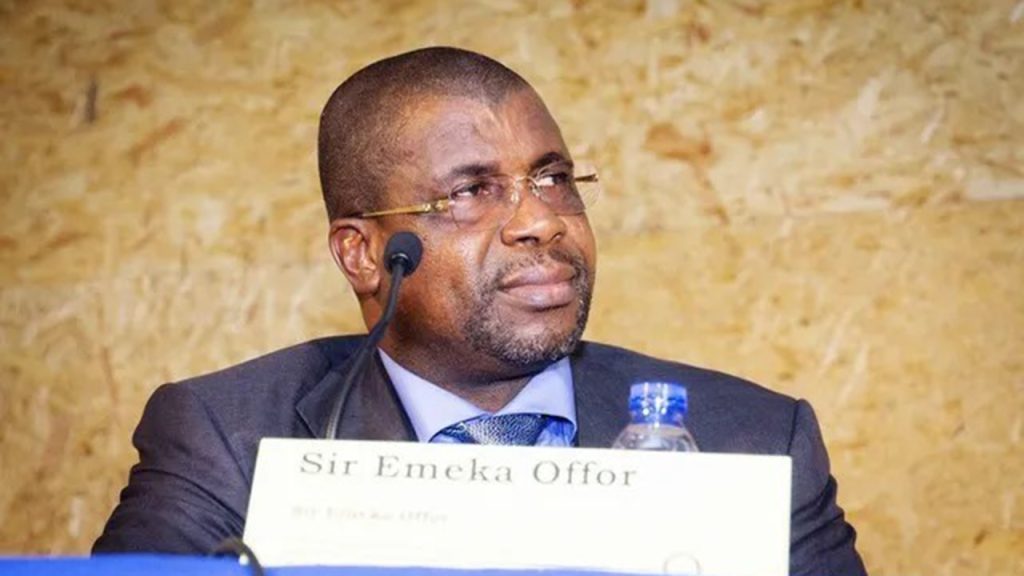
There’s a lesson every seasoned real estate developer eventually learns: cash flow builds a lifestyle, but property builds a legacy. Businesses rise and fall with markets, but land and buildings, managed well, tend to outlive the person who acquired them. Few Nigerian entrepreneurs demonstrate this principle as clearly as Sir Dr. Emeka Offor, founder and Group CEO of Chrome Group, one of West Africa’s leading diversified conglomerates.
This post looks at how Offor built his business empire, how real estate became one of the anchors of his investment portfolio, and how that approach to property helped convert commercial success into a legacy that will outlast him.
Humble Beginnings, No Inherited Land
Offor was born on 10 February in Kafanchan, Kaduna State, the first of ten children born to a policeman, Mr Benneth Offor. His family hails from Irefi Oraifite in Ekwusigo Local Government Area of Anambra State. He attended Eziukwu Primary School in Aba, then St. Michael’s Primary School in Ogbete, Enugu, before secondary education at Merchant of Light School and Abbot Boys High School, Ihiala.
He didn’t inherit land, capital, or a portfolio. He didn’t even hold a university degree in the conventional sense, his honorary doctorate in entrepreneurship, awarded by Nnamdi Azikiwe University in 2019, came only after he had already built his empire. Every asset he came to hold, including property, was acquired, not inherited.
Learning the Business Before Owning the Assets
After a brief spell teaching at his old secondary school, Offor left for Warri, Delta State, to work with a family friend, Pa Geoffrey Abadi. He took up employment with Rivways Lines Nigeria Ltd, a bitumen-importing company, where he learned the fundamentals of trade, logistics, and industrial servicing.
This period matters for anyone thinking about property investment: Offor didn’t start by buying real estate speculatively. He first built capital and industry knowledge through active business, then used the proceeds to acquire durable assets, including land and buildings, once he understood how value moved through an economy.
From Chrome Oil Services to a Multi-Sector Conglomerate
In 1985, Offor established Chrome Oil Services Limited, initially an engineering outfit handling projects like refinery maintenance. By 1994, this had grown into The Chrome Group, headquartered in Abuja, with subsidiaries such as Kaztec Engineering, Nimek Investments Limited, Global Scansystems, Chrome Insurance Brokers, and Interstate Electrics.
As the Group matured, its interests expanded well beyond oil and gas into finance and investments, telecommunications, insurance, maritime and destination inspection, power (Chrome Group holds a controlling interest in the Enugu Electricity Distribution Company, EEDC).
Real estate isn’t a side note in Chrome Group’s story; it’s listed among the Group’s core non-oil ventures alongside insurance and destination inspection. Much of this real estate activity sits under Nimek Investments Limited, described as the private holding vehicle that consolidates Offor’s diverse interests across energy, real estate, logistics, and finance.
Why Property Became a Legacy Anchor
For an oil and gas magnate operating in a sector known for volatile prices and long project cycles, property served a distinct purpose in the portfolio:
- Stability against commodity cycles. Oil and gas revenue swings with global prices; real estate holdings provide a steadier, longer-horizon store of value that isn’t tied to the same volatility.
- A tangible, transferable asset. Unlike a services contract or an oilfield licence, land and buildings can be passed down, leased, developed further, or sold across generations without depending on the original business relationships that created them.
- Diversification that reinforces the core business. A conglomerate with power, finance, and real estate interests is structurally more resilient than one relying on a single sector — each asset class supports the others.
This is precisely the logic professional real estate developers apply when advising clients to hold property as a hedge against business-cycle risk: it’s an asset class that tends to appreciate and endure, even when the ventures that funded its purchase go through difficult seasons.
Emeka Offor Plaza, Onitsha
Emeka Offor Plaza, also known locally as Nimek Plaza (a name that ties directly back to Nimek Investments Limited, Offor’s real estate and holding company), sits at the centre of Onitsha Main Market in Anambra State, known to be the largest market in West Africa. Located on New Market Road, close to major financial institutions such as FirstBank, UBA, and Access Bank, the plaza houses 272 shops and has become the tech and telecommunications hub of the state, where phones, accessories, and electronic gadgets are sold, repaired, and assembled.
The plaza is reported to draw close to 10,000 customers a day, with shop owners doing significant daily turnover and even informal traders (“side hustlers”) earning a living off the foot traffic it generates. Over time, the plaza’s influence has grown so strong that it has effectively absorbed neighbouring plazas into its identity many visitors to the area no longer distinguish between Emeka Offor Plaza and the smaller plazas around it.
This is what a well-placed real estate investment does at scale:
- It generates recurring income, not a one-off gain, hundreds of shop tenants paying rent, day after day, year after year.
- It anchors an entire micro-economy around it, creating value for people who have no direct business relationship with Offor or Chrome Group.
- It compounds in relevance over time a market plaza doesn’t need reinvention to stay valuable; it just needs to keep serving the commerce happening around it.
- It builds a name that outlives a single deal. The plaza carries Offor’s name into a market that sees thousands of people daily, cementing recognition far beyond his corporate or philanthropic circles.
Turning Wealth Into Institutions: The Sir Emeka Offor Foundation
Property and business success on their own don’t make a legacy, what’s done with them does. Offor’s most defining move outside of Chrome Group has been the establishment of the Sir Emeka Offor Foundation (SEOF), through which he has funded scholarships, built and furnished classroom blocks, donated over $10 million worth of books and educational materials in partnership with Books For Africa, established free health centres, and funded a glaucoma research grant and surgical fellowship at the University of Mainz, Germany.
Notably, some of this philanthropic infrastructure is itself real estate, schools, classroom blocks, and health centres are physical assets built to serve communities long after the initial donation is made. In this way, Offor’s property instincts extended beyond personal
wealth-building into public-purpose construction, reinforcing the same principle: build something that stands after you.
This combination of business consistency and community investment saw him named Vanguard Businessman of the Year in 2024.
The Real Legacy: A Forever Asset
The throughline in Offor’s story is this: a legacy isn’t the size of a bank balance, it’s what keeps generating value, in bricks, land, and institutions, long after the person who built it has stepped back.
He built this in three layers:
- A diversified, property-anchored business. By holding real estate alongside oil and gas, power, and finance, Chrome Group and Nimek Investments created assets designed to outlast any single market cycle.
- Physical, purpose-built philanthropy. Classrooms, health centres, and community infrastructure funded through SEOF are assets in their own right, ones that continue to serve people regardless of Chrome Group’s commercial fortunes.
- A reputation as a model to replicate. By pairing profitability with visible community investment, Offor created a template other Nigerian entrepreneurs and developers can study and follow.
What Real Estate Developers and Investors Should Take From This
- Earn before you acquire. Offor built capital and industry knowledge before acquiring durable assets, property investment works best funded by real business understanding, not speculation alone.
- Use property as a stabiliser, not just a growth play. In a portfolio with volatile sectors, real estate holdings provide the ballast that keeps the whole structure standing.
- Build for permanence. Whether it’s a family compound, a commercial block, or a community facility, construct with the next generation in mind, not just the next sale.
- Let your assets serve a purpose beyond yield. The classrooms and health centres funded by SEOF show that property built for community impact compounds reputation as well as returns.